Securing supply chains for the green transition
Securing supply chains for the green transition
Can EU trade and industrial policy reduce supply chain dependence on China?
Amid rising trade tensions, the EU is placing greater emphasis on securing supply chains for technologies vital to the green transition. Yet questions remain over how much it can strengthen security of supply without eroding competitiveness of European manufacturing or increasing the overall cost of decarbonisation.
Our analysis shows that the EU can reduce dependence in some sectors, but aggressive tariffs and restrictions on upstream components raise costs, invite retaliatory measures, and slow the deployment of clean technologies. In cooperation with Kaya Partners, we outline the key challenges facing Europe and set up a scenario, “Security Premium”, using our INTERSECT economic model to assess trade-offs between resilience, supply chain security, industrial competitiveness, and cost efficiency.
Current EU dependence on the four key transition technologies
Europe’s reliance on Chinese solar components is currently very high, with China’s cost and scale advantages dominant. This dependence is expected to persist, limiting Europe’s ability to diversify supply, while wind is expected to remain particularly strong in assembly, but with a reliance on Chinese sub-components for wind turbines. Similarly, battery supply represents a growing dependence in both production and critical raw materials globally, which also potentially exposes the EU’s dependence on EV batteries from Chinese suppliers, representing a supply chain vulnerability.
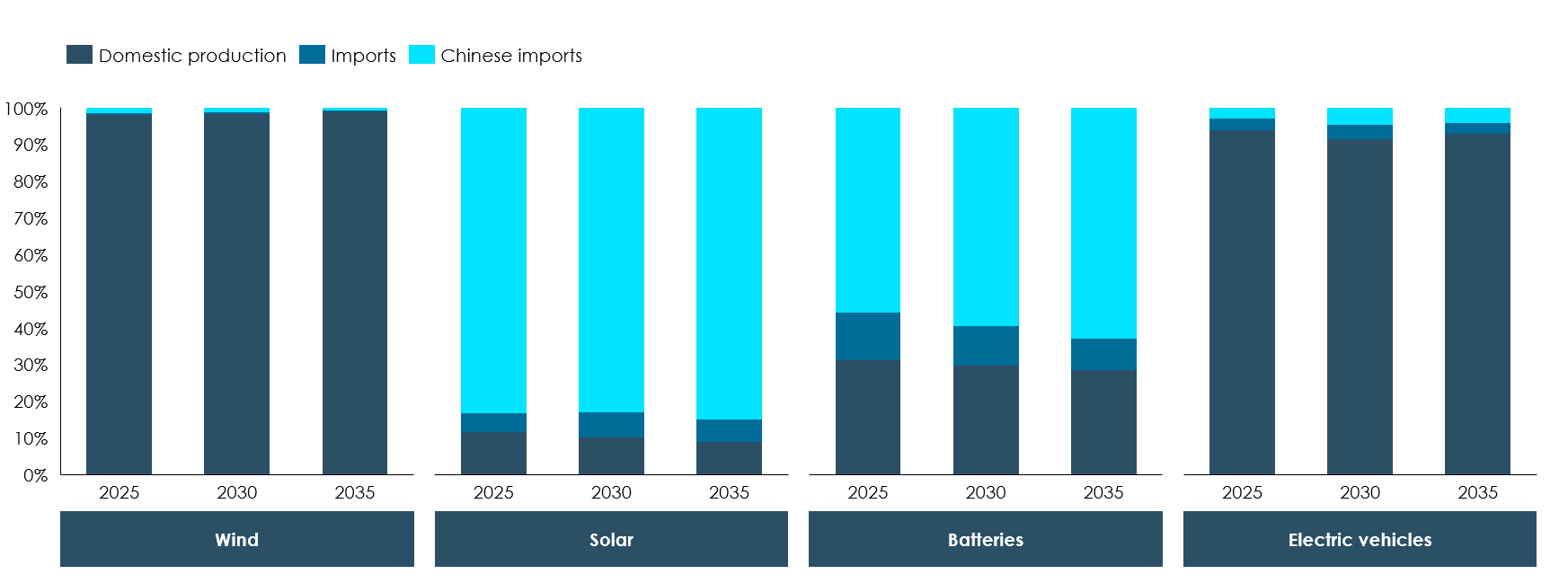
Figure 1
EU domestic production and dependence on imports (Chinese & other) in the status quo
Our “Premium Security” scenario in short
The scenario is as follows: From 2026, the EU acts decisively to reduce reliance on Chinese supply chains. Policy measures include tariffs, targeted subsidies, and restrictions on foreign direct investment (FDI), while still permitting FDI in selected sectors to encourage technology transfer. The tariffs are not permanent and reduced by half after a period of 5 years. To capture potential retaliation, China is assumed to impose export bans on permanent magnets for wind turbines and restrict selected solar and battery components.
Impact of the projected policy on the EU supply chain
Examining the effects of the scenario, we find the following:
Solar: Europe reduces reliance on China in the short term, shifting to India and Southeast Asia until 2030, but Chinese imports rebound by 2035 due to cost advantages, tariff reductions, and limited alternative capacity.
Wind: China’s export ban on permanent magnets raises turbine costs slightly, but overall wind deployment in Europe remains largely unaffected.
Battery: Tariffs and Chinese export bans shrink supply sharply—down 10% by 2030 and 46% by 2035—since alternative suppliers and EU production capacity are insufficient.
EV: Falls sharply (16% in 2030, 48% in 2035) due to unavailable domestic supply and constrained Chinese imports.
The limits of unilateral policymaking
This scenario exposes the vulnerability of the EU’s reliance on Chinese imports and the limits of policymaking in addressing this without careful consideration of current and future supply chain availability. Strengthening Europe’s green industrial base requires combining targeted investment in domestic manufacturing with diversified international partnerships.
Read the full Insight piece below and find more detailed findings within.